Showing posts with label thoughts. Show all posts

Tuesday, October 07, 2008

Unvetty?

Having bounced round the internet a little this evening I've realised that of the vetty blogs out there (for example, or try this one)mine is distinctly un-vetty. Partly this is because I am excited by things other than vetting, and don't want to bore people with the boring details of "today in lectures I learnt...", but maybe it's a shame. I don't know really.

Interestingly, have discovered a new fun way of learning diseases. It's a game called "I have a cow...", and essentially you think of a disease and someone has to work out what is wrong with your cow in a 20 questions yes/no style. It's a bit sad, but very useful. So far this evening Alex and I have covered RDAs, Milk Fever, Pulmonary adenomatosis, caseous lymphadenitis (yes, we branched out into sheep), white line disease and coccidiosis. Huzzah!

Friday, May 30, 2008

Amnesia...?

So anyway, little thought for the week. A hypothetical situation to consider…

I am given a drug - a perfect amnesiac, producing 100% amnesia, but no analgesia, muscle relaxation, loss of consciousness etc. This drug is administered for 1 hour, and lasts for only 1 hour, by which time it wears off instantly. During this one hour period, I am exposed to a painful stimulus, say a capsaicin infusion that lasts only 10 minutes, before wearing off with no lasting pain.

During this 10 minute period, I can of course feel the painful stimulus, I have not been given any analgesia. However, as far as I would be aware, I would also have “woken up” one hour after the analgesic was administered. Extreme cases of amnesia result in people believing they have woken up for the first time regularly, as they have no memory of anything that has happened in the past. So, if I was effectively “asleep”, though 100% conscious during that time, and presumably able to scream at the pain, if I feel, after 1 hour that I was asleep the entire time, did I actually “feel” the pain - was my welfare compromised?

It’s a really interesting question I think!

Monday, May 12, 2008

Thoughts

Jesus' 1st instinct when confronted with the sick was to heal. Lepers, the blind etc. So a god doesn't 'like' suffering, he hates it.
I'm sure I've lost a proportion of my readership already (however many you are). Simply using the J word evokes emotions in most people - in many, fear, confusion, anger, pity and resentment. I know for me the word still conjours up images of South American States-types preaching "Jesus Christ, praise the lord" which I find shocking. And images of CICCU hoodies and people professing to know all the answers. People telling me I am "a parachutist without a parachute" [CU in 1st year] just succeed in scaring me off and creating a stigma for themselves and religion as a whole.
In Alastair McGrath's rebuttal to Richard Dawkins' "The God Delusion", "The Dawkins Delusion" he makes the observation that many eminent scientists and intelligent people are practicing Christians - surely they are not all "deluded" people with an "imaginary friend" as Dawkins would have you believe - do they know something I don't?
I've already had the shocking epiphany that a belief in God and an understanding of science are not incompatible (here) which was vitally important in seeing that 'God' is not a deluded excuse for not understanding. I suppose it is an explanation for that which cannot be explained; that which we can explain (his work???) we do - through science.
I don't want to be "Christian" or "religious", I'm almost ashamed of the stigma, but there is also no way I can be an atheist - it seems to be ignoring a huge proportion of the argument. I couldn't come to terms with, for example, the death of a loved one with a simple "that's the end" attitude. I would need to believe that there is something more, that I would one day see them again. Of course need is a well documented atheist explanation for the existence of religion, and that shouldn't be a starting point, but it's important.
One of my previous questions "Why church?" has been answered in a number of ways. One, an evangelical response was "If we believe that God exists, then it demands some sort of response rather than apathy as most of the British public choose" ,and another less evangelical one "it's like going to a dinner party where you've had an amazing time and thoroughly enjoyed yourself. You should say thank-you". Both I think, are good answers.
I realise that I'm mostly just presenting information here in an unstructured fashion - maybe I'll return to this later and make it more readable (perhaps a cogent argument would be useful), but at the moment I don't really know where I'm going with it, so it's difficult to structure. I'm writing this down to justify decisions I make. Any move from here will have to be one I find logical and one I believe to be valid.
To leap back to the start, suffering. People believe different things (or more than one). We have free will, and certain types of suffering (war etc.) are a result of a human abuse of this. Other, natural forms of suffering are harder to justify in a loved world. I suppose they simply result from the natural way the world is set up. Take cancer as an example. It is, in most cases, a normal cellular function taken to an extreme - cell growth uncontrolled, and the result of a mutation in the genetic code for either a "tumour suppressor gene" (TSG) or an "oncogene" (actually an 'after the horse has bolted nomenclature, like calling bones 'flaccidity preventors', or television aerials 'static removers'). All genes are mutable and this can result in their malfunction which can lead to cancer through the loss (TSG) or gain (oncogene) of function of these genes. However, of course mutation - the imperfection in the replication and maintenance of DNA is vital for the processes of evolution - without this imperfection, all species would be static, infact, most wouldn't exist at all. So in order to have evolution, there must be imperfections in the system which leave it open to pathology. Does this mean the world is imperfect? Not necessarily, it's just the way it is.

Sunday, July 29, 2007

Radio Shmadio

Last night I decided to take my minidisc player for a little outing (it has been neglected recently) across London to be used during my journey to Rahul's birthday thingie in London. Unfortunately, having exhausted my minidisc on the journey home, I found myself listening to London LBC Radio, for my old minidisc has an FM function. This LBC is a station of moaning. If you've had a particularly tough day, have read the paper (most likely the Express, or Mail) and despaired for the "way the country is going" a couple of times, then this is the station for you. I base this on 1 brief 15 minute listening on the bus on the way home at gone midnight, but it basically involved people ringing up moaning, and, more annoyingly, the DJ agreeing with everything they say, no matter how ridiculous and unfounded their ramblings. Particularly one fellow's argument , "I can't believe they're not giving out killer's names if they're under 18 to protect them. When I was under 18 I was in the army, and was trained to kill", annoyed me. I'm not entirely sure how he managed to link the two statements anyway, but the point I wish to raise is just what a good example of the "guilty until proven innocent" attitude such as that brought up by A Passage to India or Vernon God Little this is. The names of these "killers" are not given, because it is possible that they are, in fact, not killers, and if they are, we have a law system much better placed to deal with them than some vengeful member of the public who will be benefited by a name. In fact, I am often unsure of why the accused are named at all, regardless of age, unless, of course, they are on the run and may pose a risk to the public. I'm sure there will be someone reading this who will have a better idea of what I'm rambling on about - please leave a comment if you do!

In other news, Rahul's birthday was good fun. The food was pretty tasty (though I couldn't finish my main course - I blame the Tetleys Ally bought me) and the place was nice, if a little cramped and over-hot! A little shout out to Mr Todd, who has revealed his frequenting of this site to me. Keep on reading my man, and if you fancy it, leave me a comment to say hi! I hope you've recovered well from last night's shenanigans.

Saturday, July 28, 2007

We are not built to cope with all the sadness in the World

"They both regretted the death, but they were middle-aged men who had invested their emotions elsewhere, and outbursts of grief could not be expected from them over slight acquaintances. It's only one's own dead who matter. If for a moment the sense of communion in sorrow came to them, it passed. How indeed is it possible for one human being to be sorry for all the sadness that meets him on the face of the earth, for the pain that is endured not only by men, but by animals and plants and perhaps by the stones? The soul is tired in a moment, and in fear of losing the little she does understand she retreats to the permanent lines which habit or chance have dictated and suffers there."

EM Forster, A Passage to India, p219.

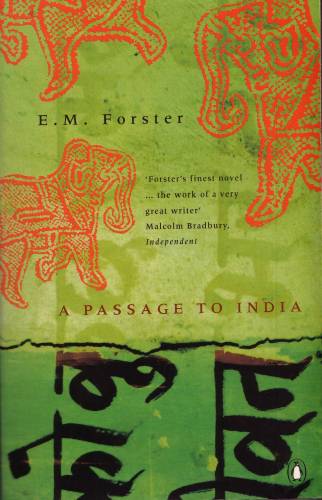
A Passage To India

Before I start, I should just give a small warning that this post may give away some of the storyline. However, I would suggest that this book should not be read so much for the intrigue of what happens to Aziz, but for the people and politics surrounds that story. It sounds like a bold and pretentious statement, but in fact the main story framework is extremely small - it is its telling that I found most fascinating.

Aziz is an Indian doctor working in Chandrapore. From the beginning of the book he sparks a friendship with Mrs Moore and Miss Quested, two English ladies, and eventually invites them an some other friends on a trip to the Marabar Caves. During this trip, Aziz and Miss Quested become separated from the rest of the group, and the result is that Aziz is accused of assaulting Adela, who appears to run from the caves. From the moment of his arrest the affairs of Aziz are never mentioned - you have no idea of what has been happening to him, except through the biased words of the Anglo-Indians, who never once mention his name - he is always "the prisoner". This is just an example of the guilty-until-proven-innocent attitude of authority in this book. As soon as the trial falls apart, Aziz is mentioned by name again as if nothing has happened, and he re-enters the story. "From the moment of his arrest he was done for… he had despaired, not through cowardice, but because he knew that an English-woman's word would always outweigh his own." p208.

It's a fascinating insight to the years of Colonial India, and exposes the racism inherent in the system. As I read the book I was filled with a constant feeling of respect for Aziz - it's the way it's written. Because you see all that happens - you are aware of Aziz's innocence and intentions all along, all the prejudice around him is shocking. Perhaps also as he speaks perfect English, and, being a book, you do not really have any idea of the colour of his skin it feels even more shocking. I wonder if this book changed any opinions in the 20s?

Wednesday, May 30, 2007

Real Magic

Nnrgh - I can't sleep. Winding down time with a bit of a conundrum - I'm not eloquent on the subject, but here's the way it seems.

My fear is thus: If one assumes there is a "god", for want of a better term, then all I have spent the last 3 years learning about is pointless.

Why? If one assumes there is a "god", then all the glorious feats of science and biology that I am confronted with, baffled with, and amazed by are nothing but simple creations to him. It's not this apparent simplicity that upsets me, more the "magic". It' s all here by magic. Our hugely complex physiology is all there by magic, the brain... magic... he did it. Oh... How dull.

Here comes the revelation (I'm sure it's been said before a million times, a million ways, but it's a personal realisation that has got me thinking properly for the first time about this subject). Maybe it is "magic", but, magic that functions in a way we can describe - science. It is incredible, but explainable. Where does this leave God? There's no reason why there shouldn't be a God. Science can explain a lot extremely well (the expression patterns of Engrailed in the Drosophila parasegments to take a poignant example), but surely a point will be reached where we just cannot explain some things - they'll be outside our field of understanding? Is such a wangling in of God into scientific understanding just an "easy way out" for the religious? I'm no longer sure that it is. Many scientist are religious, and they are certainly not "deluded fools" as Dawkins would have you believe.

Why God? this is my main problem now. I've leaped over the "Science and God are mutually exclusive" boundary (that, incidentally, Dawkins still seems to be stuck behind), but why bother with believing in something so unbelievable, why bother with "Church" (though of course, by church I mean any sort of religious ritual)? I'm working through these parts slowly... but it's an interesting journey. This "real magic" point really has excited me, but I'm still nowhere near anything but agnostic.

Any (constructive - no knee-jerks) ideas are welcomed.

Wednesday, November 22, 2006

Late night ramble

I'm sure that each of the terms at Cambridge has had a single buzzword, and the word for this term so far is "tea". We've all been very civilised and drunk a lot of tea. I'm feeling so de-oxidised that... Tom tries vainly to think of a witticism that relates to anti-oxidants... I'll get back to you.

Only a week and a half left of term to go! Can ye believe it? Well, I can't, though looking back on the first day of term when Tom, Vicky and me went t't pub for dinner, it seems like aaages ago. The usual "I've been here for ages, but how has it gone so quickly" thing.

Work has been... interesting. I go through phases with embryology. It's fascinating, but it's also possible to look into something into so much detail that it loses all meaning... to an extent, I feel that's what's happening. Every gene is named... but as such, all these names are so arbitrary that there seems to be no point to them.. but then I guess all words are. Anyway - enough of the genetic biologist bashing. Some of it has been very interesting, for me the stuff on a larger scale (somite formation, mesoderm patterning, limb bud specification, that sort of stuff) is what grabs me. Fetal and placental is good at times, but gets so (necessarily) hormonal that the papers I'm reading are just a list of unconnected facts. IGFII does this, and is up regulated here, here and here, but down regulated here. here it does one thing, there it does another, unless it's Wednesday, in which case it goes shopping with Cortisol...

Humm... it's very early, and I should be in bed...

Was nearly late for my lecture this morning... went to get my bike, and realised it wasn't there - I'd left it outside old court when we went to see Tom's recital in chapel (very good it was too!), so, I had to powerwalk. Made it just in time. Missed her 1st few words, but no more. Hahah!

Tom played Brahms on Monday in chapel. A little thingie for piano and viola - started off quite simple, and really built on that in the 2nd and 3rd movements. He played really well, though I think the piano was a little too loud.. perhaps next time they should move the piano back a bit, and/or him forwards a bit?

I've submitted my dissertation applications! Stay posted for more details.

Sleeeeeep

I'm writing an essay - I've been trying to do it for 5 weeks on and off (mostly off) now - such is the problem when you have no deadlines. It's just impossible to do! Never thought I'd be complaining about the lack of essays, but they're actually really useful.

My apologies for the obsessive use of italics in this post.

Nightnight!

Tuesday, October 18, 2005

Sweatshop Yoghurt?

Sorry for not posting for a while.

Image Hosted by ImageShack.us

For one reason or another, I always get an attack of conscience when buying economy sainsbury's foods from their budget range. For example, the other day I bought a pack of 4 yoghurts for 29p. Surprisingly they tasted very nice, and I am still here to tell the tale, but, I did feel guilty as I saw it roll through the checkout, probably for a number of reasons

  • I was disgusted at what I was doing to myself
  • What state would the cows that produce the milk be in? Though, assuming the milk is British (shipping in cheap milk is surely economically stupid), then the cows would be of an "acceptable" (on British scale) standard, and milk from different farms is mixed up anyway.
  • Was the fruit abused? Were the peaches that went into my peach melba made to work inhuman hours? Perhaps... it is not a human afterall.
I also bought economy muesli yesterday (59p for 1kg) - the same question can be said of the oats and the nuts.

In conclusion, I do not know, but, my bank-balance will force me to selectively buy economy foods - but only those that I can see few ethical qualms with.

Tom xxx